

“Best Agricultural Newsletter in Hawaii”
Newsletter of the Kona Coffee Farmers Association
March 2026
PO Box 5436 Kailua Kona Hawaii 96745 USA
www.konacoffeefarmers.org info@konacoffeefarmers.org
Contents
Message from President Petersen
Symposium Presentations 2026
Symposium Photos 2026
USDA Tells Specialty Crop Growers to Report Acres for Aid and Reporting Details
Large Coffee Farm Management: “The Kona HiIls Experiment”
Why Honey Bees Matter For Kona Coffee-Conversation
Why is Colombia Producing so Many Co-Fermented Coffees
The Growing Call for Ethically Sourced Coffee
Study: Coffee Linked to Improved Cognitive Function in Atrial Fibrillation Patients
Vietnamese Police Seize over 4 Tons of Fake Coffee Products
Climate Change Adding Weeks of Coffee-Harming Heat in Major Growing Regions
Designing Coffee Packaging
Study: Drinking Coffee Daily May Reduce the Risk of Developing Dementia
Hot Tea or Iced Coffee
Sample of KCFA Website Blocks
Editor: Clare Wilson
Message from President Petersen
Aloha Coffee Farmers,
Mahalo to everyone who joined us last week for the KCFA Coffee Farmers 2026 Symposium. It was inspiring to see so many farmers come together for a full day of learning, connection, and shared purpose. Your presence and participation are what make this Association strong.
We welcomed ten speakers this year, each offering practical, timely information for our farms. A standout highlight was Dr. Irwin Donis-González, extension scientist at the UC Davis Coffee Center, who delivered an exceptional presentation on post-harvest processing. He walked us through the specific steps that most influenced final cup quality and emphasized how careful, consistent practices can help every farm achieve its highest potential.
Throughout the day, we also heard updates on several agricultural programs including the innovative research conducted at the USDA-ARS laboratory in Hilo. Other speakers reported programs that can support our operation, from worker housing resources to the latest on implementing the 51% labeling law. A detailed economic overview of Hawai‘i’s coffee sector underscored the importance of long-term data collection. Many of you committed to participating in a multi-year survey on marketing, production costs, and revenues. Your contributions will help us understand the real impact of the labeling law and strengthen our advocacy.
During a late summer Board meeting, a proposal was brought forward by a member of KCFA to launch a KCFA/Farm Sign Program. These 12×18 aluminum signs will feature both the KCFA logo and each farm’s own logo. The board displayed a demo sign at the symposium, and a number of farmers decided to purchase one or more. The order form will soon be on the web page and you can order from there..

KCFA Road Sign example (with out that 4 )
)
Looking ahead, please save the date: next year’s symposium will take place in the second week of March. We will confirm the exact date once the venue is finalized.
It was wonderful to see so many of you in person. Wishing everyone a productive, healthy, and hopeful March as we move into the next phase of the coffee production year.
Mahalo nui loa!

Mark Petersen, KCFA President
2026 Symposium Presentations May be Found here (Thank you Suzanne)
https://konacoffeefarmers.org/
Photos from the 2026 KCFA Symposium

KCFA Board for 2026

Dr. Irwin Donis-González,- UC Davis Coffee Center

Dr. Melissa Johnson-USDA ARS
USDA Tells Specialty Crop Growers to Report Acres for Aid
includes Coffee & Macadamia Nuts
https://www.thefencepost.com/

“The Agriculture Department on Friday told growers of specialty crops they have until March 13 to report 2025 acres to get payments under the $1 billion Assistance for Specialty Crop Farmers Program that the Trump administration has set up to cover crops not covered through the previously announced Farmer Bridge Assistance Program.
Specialty crops include fruits, vegetables, dried fruit, tree nuts, nursery plants and other products.
USDA said, “These one-time bridge payments will help address market disruptions, elevated input costs, persistent inflation, and market losses from foreign competitors engaging in unfair trade practices that impede exports.”
The announcement did not say when farmers would receive the payments….”
Reporting Details
Hawaii Island growers should contact their Hilo FSA office as soon as possible to begin the reporting process and avoid the last‑minute rush.
Acreage Reporting Checklist – 2025 (Due March 13, 2026)
Basic Information
☐ AD‑2047 (only if new to FSA/NRCS or personal info changed)
☐ Lease, deed, or land documents (if not already on file)
☐ TMK number(s) for all planted areas
Crop Information
☐ List of all crops planted in 2025
☐ Crop type/variety for each crop
☐ Total acreage planted for each crop
☐ Planting dates for each crop
☐ Intended use (fresh, processed, etc.)
☐ Identify which crops are irrigated
☐ Identify which crops are organic
Field Mapping
☐ Review FSA‑provided map
☐ Draw crop field locations on the map
Tree Crop Details (if applicable)
☐ Number of trees for each crop
☐ Row spacing and tree spacing
Large Coffee Farm Management: “The Kona Hills Experiment”
https://coffeetalk.com/daily-
“…By 2023, MERS had lost confidence in the coffee farm and renewable fuels investments. The pension fund severed ties with Verdantf and Domain, transferring the assets to Ospraie Management. In September, MERS sued Verdantf and its founders, alleging that they concealed risks and used MERS’ money to salvage personal investments. A lawyer for Verdantf disputed the allegations, stating that MERS invested an additional $136 million with Verdantf in other projects and earned approximately 10% annually.
Ospraie discovered issues at the coffee farm, including citations for drainage problems, illegal employee housing, and unauthorized septic tanks. AgAmerica, the farm’s lender, initiated foreclosure proceedings in June and is suing MERS and Domain for fraud, alleging they failed to disclose the violations when applying for a loan in 2022. Both MERS and Domain deny the allegations. A new team is currently managing the coffee farm, addressing the drainage problems and other issues. The illegal housing has been shut down, and the crop has been limited to 400 acres. The Kona Hills farm is currently in foreclosure and seeking a new owner.”
Why Honey Bees Matter for Kona Coffee
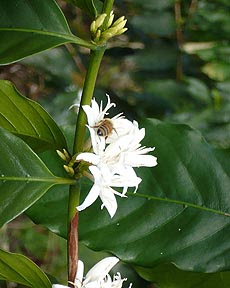
Coffee flowering season is one of the most beautiful and consequential moments in our orchards. While Coffea arabica is capable of self-pollination, the presence of insect pollinators—especially honey bees—can dramatically increase fruit set, seed development, and overall yield. For Kona farmers, understanding how pollination works and how to support pollinators can translate directly into healthier trees and higher-quality coffee.
How Coffee Pollination Works
Coffee flowers are perfect flowers. This means that each blossom contains both male (anthers) and female (stigma) structures. Arabica can self-pollinate, but the mechanics of pollination improve significantly when insects move pollen between flowers.
- Self-pollination occurs when pollen from the same flower or same plant reaches the stigma. This process is reliable but limited.
- Cross-pollination happens when insects transfer pollen between flowers on different branches or different trees, increasing genetic mixing and stimulating stronger fruit development.
Honey bees and other insects brush against the anthers as they forage for nectar, picking up pollen grains and depositing them on the next flower’s stigma. This simple act increases the number of fertilized ovules, which directly influences the number of seeds per cherry and the uniformity of bean development.
Pollination Rates: With and Without Insects
Scientific studies consistently show that insect pollination boosts both fruit set and seed quality in Coffea arabica.
- A 2025 study evaluating honey bee access found that trees open to all insect pollinators produced significantly higher fruit set and seed yield than trees caged to exclude pollinators. Trees caged with honey bees also outperformed self-pollinated controls, demonstrating the direct contribution of managed hives. Springer
- Research from Costa Rica and CATIE shows that bee pollination improves not only yield but also coffee quality, with measurable effects on bean size and uniformity. CATIE
- Global assessments estimate that bees contribute roughly 40% of the world’s coffee production, underscoring their importance even in self-fertile varieties like Arabica. irescuebees.com
In practical terms, this means that farms with strong pollinator activity can expect more cherries per node, more seeds per cherry, and better-developed beans—advantages that directly influence both volume and cup quality.
 For more information on pollinators and how coffee farms can better support pollinators, follow this link:https://
Why is Colombia Producing so Many Co-Fermented Coffees?
https://tinyurl.com/4y2fpjhp

- Colombia has built a global reputation for consistently clean washed coffees.
- It is also emerging as one of the world’s largest producers of co-fermented coffees.
- Co-fermented coffees use external organic substrates such as fruit pulp, musts, or cacao pulp during fermentation.
- When producers apply transparency and technical skill, co-fermentation supports Colombia’s push to innovate.
“For decades, washed coffees, often described as “milds”, defined Colombia’s coffee identity. Through its national coffee federation, the FNC, the country invested heavily in infrastructure and standardised processing. This strategy cemented Colombia’s reputation for clean, consistent flavour profiles, but it also limited deviation from established norms.
In recent years, that position has shifted as co-fermented coffees formed a distinct category within specialty coffee. Producers in Panama, Costa Rica, and Brazil have also adopted co-fermentation, but Colombia now leads in scale and visibility.
Differentiation drives much of this growth. “Producers are under pressure from rising costs and price volatility. Co-ferments offer a way to add value fast,” says Isis Couto, UK Relationship Manager at Colombian producer and exporter Forest Coffee. “At the same time, roasters want coffees that turn heads and spark conversations.”…
The Growing Call for Ethically Sourced Coffee
https://coffeetalk.com/daily-
“Coffee has become a significant aspect of American culture, evolving from a symbol of patriotism following the Boston Tea Party to a staple in informal business meetings, ultimately making the U.S. the leading country in coffee consumption. However, coffee’s history is complex and intertwined with slavery, exploitation, and environmental degradation, as noted by Dr. Mauricio Espinoza, an expert in Latin American culture and coffee history. He argues that consumers should prioritize fair trade products that ensure equitable wages and minimize ecological harm from unsustainable coffee production practices.
Espinoza shares his personal connection to coffee, having been born in a coffee mill in Costa Rica and worked on farms from a young age. He highlights the labor-intensive nature of coffee harvesting, which typically occurs from September to February, requiring workers to pick ripe coffee cherries multiple times due to staggered ripening. Additionally, he discusses the migration patterns driven by coffee production, identifying Brazil’s historical reliance on immigrant labor following the abolition of slavery in the late 1800s and the subsequent pressures on coffee-growing communities from fluctuating prices and climate change….”
Study: Coffee Linked to Improved Cognitive Function in Patients with Atrial Fibrillation
https://tinyurl.com/2sy6s56v

“…The research, involving more than 2,400 participants, found a dose-dependent association between daily coffee intake and enhanced cognitive performance, with as little as one cup a day shown to increase performance.
Patients consuming more than five cups per day demonstrated the highest cognitive scores, equating to a reduction in “cognitive age” by 6.7 years, based on standardized tests like the Montreal Cognitive Assessment (MoCA), according to the study.
Led by a team based in Switzerland and involving a cohort of Swiss patients, the study was recently published in the Journal of the American Heart Association….”
Vietnamese Police Seize over 4 Tons of Fake Coffee Products Made From Soybeans
https://coffeetalk.com/daily-

“Police in Vietnam have initiated a criminal investigation into a warehouse suspected of manufacturing counterfeit coffee from soybeans, following a raid conducted in the Central Highlands province of Lam Dong. The Ministry of Public Security reported the seizure of 4.1 tons of fraudulent coffee products and 3 tons of raw materials during this operation. Luong Viet Kiem, the warehouse owner, confessed to mixing soybeans and flavorings with real coffee beans to produce ground coffee destined for the local market….”
Climate Change Adding Weeks of ‘Coffee-Harming Heat’ in Major Growing Regions
https://tinyurl.com/3yx6x2yr

A new analysis found that climate change has already added weeks of “coffee-harming” heat to the world’s main coffee-producing regions, threatening future supply and the livelihoods of millions of smallholder coffee farmers.
Released today by the policy-neutral nonprofit Climate Central, the analysis found that the number of days topping the heat-stress threshold increased across all 25 coffee-producing countries studied, representing 97% of global coffee production.
Using temperature observations from 2021 through 2025, the analysis focused on days when maximum temperatures exceeded 30°C (86°F), a threshold the group described as “extremely harmful” for arabica plants and suboptimal for robusta. Heat stress at those levels can reduce yields, affect bean quality and increase vulnerability to pests and disease.
“Coffee farmers in Ethiopia are already seeing the impact of extreme heat,” Dejene Dadi, general manager of Oromia Coffee Farmers Cooperatives Union (OCFCU), said in a statement shared by Climate Central. “To safeguard coffee supplies, governments need to act on climate change. They must also work with, and invest in, smallholder coffee farmers and their organizations so we can scale up the solutions we need to adapt.”
Designing Coffee Packaging
https://tinyurl.com/m8pjynfe

“…Why coffee packaging has evolved
Today’s hyper-competitive specialty coffee market demands exceptional packaging as standard. Once little more than a functional container, it’s now a primary means for roasters to capture the attention of increasingly discerning consumers.
Millennials and Gen Z, a dominant force in specialty coffee consumption, are highly attuned to visual presentation and social media.
“Younger consumers are driving a huge shift in how roasters present their coffee,” says Mark Zhou, founder of MTPak Coffee. “The rise of unboxing culture means packaging has to be exciting, shareable, and visually striking; it’s part of how people experience and talk about coffee online.”
With many customers encountering new roasters online or on café shelves for the first time, packaging often serves as the initial point of contact.
“It’s the first physical interaction someone has with a product,” says Tony Collins, creative director at People Possession. “Before taste and aroma, you see and touch the packaging. And that sets expectations.”
This emphasis on sensory experience has elevated packaging from a practical necessity to a form of brand storytelling. Design choices are increasingly intended to build anticipation and signal quality before a bag is opened.
Simultaneously, this demonstrates that the shift is not purely commercial. “Packaging increasingly reflects the culture of specialty coffee,” Mark explains. “It’s modern, confident, and design-led. For many people, coffee is a lifestyle product, and its packaging reflects that.”…
Study: Drinking Coffee Daily May Reduce the Risk of Developing Dementia
https://www.comunicaffe.com/

“LOUGHBOROUGH, Leicestershire, UK – Scientists have found that drinking two to three cups of coffee a day may significantly reduce your risk of developing dementia, but drinking more won’t help protect your brain any further. A major study tracked 131,821 American nurses and health professionals for up to 43 years, starting when they were in their early 40s. During this time, 11,033 people – around 8% – developed dementia. But those who drank moderate amounts of caffeinated coffee or tea were notably less likely to be among them.
The protective effect was strongest in people aged 75 or younger, who saw their dementia risk drop by 35% if they consumed around 250mg-300mg of caffeine daily – roughly two to three cups of coffee. Crucially, drinking more than this didn’t provide any extra benefit….”
Commenting for Medscape Medical News, Courtney Kloske, PhD, director, scientific engagement, Alzheimer’s Association, Chicago, emphasized that a balanced and healthful overall diet may be more beneficial for brain health than focusing on one beverage or ingredient.
“While the modest cognitive benefits for higher levels of caffeine consumption are intriguing findings, more research is needed to better understand the underlying mechanisms and connections between caffeine and cognition,” said Kloske, who was not part of the study.
The observed benefits could also relate to other lifestyle and cognitive factors of caffeine drinkers, such as sleep, exercise, and reading, she noted, advising that clinicians emphasize comprehensive healthy lifestyle practices instead of focusing on individual dietary factors like caffeine.
“Developing healthier habits can improve overall wellness and protect memory and thinking as we get older,” she said.”
Hot Tea or Iced Coffee
https://tinyurl.com/39ewucju
“Whether it’s hot chocolate or iced coffee, the temperature of drinks — and when you drink them — may influence your mood, according to researchers.
A new study, published in the British Journal of Nutrition, was shared in a San Diego State University news release on Sept. 22. Over 400 American adults were involved, all of whom were Asian or White.
“Researchers found food and beverage temperature, long recognized in traditional Asian medicine, has measurable links to anxiety, insomnia and gut discomfort,” SDSU said in the release.
Drinking more cold beverages during warmer months was associated with “increased anxiety, more sleep disturbances and greater feelings of abdominal fullness” among Asian participants, according to the study.
The White participants, however, reported less depression, enhanced sleep quality and fewer gastrointestinal problems when they drank hot beverages in winter.
Researchers attribute the differing patterns largely to cultural consumption habits and individual temperature sensitivity — stronger effects among participants with “cold hands” — with notable variation within Asian subgroups. They emphasize that the results show correlations, not causation, and are based on self-reported data.”
KFCA Website Blocks for 2/9/2026 am
Interesting to see a sample of the attacks on the KCFA website in one morning
| Time | IP / Action |
|---|---|
| February 9, 2026 11:15am |
141.98.10.136 (Lithuania) Blocked for Known malicious User-Agents |
| February 9, 2026 11:15am |
141.98.10.136 (Lithuania) Blocked for Known malicious User-Agents |
| February 9, 2026 7:40am |
139.59.110.233 (Singapore) Blocked for Known malicious User-Agents |
| February 9, 2026 7:09am |
203.159.90.20 (Netherlands) Blocked for Known malicious User-Agents |
| February 9, 2026 7:09am |
203.159.90.20 (Netherlands) Blocked for Known malicious User-Agents |
| February 9, 2026 7:09am |
203.159.90.20 (Netherlands) Blocked for Known malicious User-Agents |
| February 9, 2026 7:09am |
203.159.90.20 (Netherlands) Blocked for Known malicious User-Agents |
| February 9, 2026 7:09am |
203.159.90.20 (Netherlands) Blocked for Known malicious User-Agents |
| February 9, 2026 7:09am |
203.159.90.20 (Netherlands) Blocked for Known malicious User-Agents |
| February 9, 2026 2:02am |
203.159.90.20 (Netherlands) Blocked for Known malicious User-Agents |
and 101 additional attacks
 RECIPES WANTED If any of you have recipes that you would like to share, please submit them to the editor: clarewilson98@gmail.com
 Suggestion Box Let us know what you would like to see in our newsletter. Suggestions on what to include or not. What could we do better? Let us know. Clarewilson98@gmail.com
 LET US KNOW WHAT YOU THINK! >> Write to us. We welcome Letters to the Editor up to 150 words. We reserve the right to edit for clarity and length. Include your name and email address >> Email: info@KonaCoffeeFarmers.org with SUBJECT: Commentary.