

Musician/Coffee Farmer

Colombia Coffee Federation – How they protect the Colombian Coffee name

President Bruce Corker to Colombia Coffee Federation From: corkclan@msn.com To: luisfernando.samper@cafedecolombia.com CC: harold@hoogasian.com; josel.londono@cafedecolombia.com; senhee@capitol.hawaii.gov; repcoffman@capitol.hawaii.gov; sandra.kunimoto@hawaii.gov; john.m.ryan@hawaii.gov; gomesgomes@yahoo.com; pgee@starbulletin.com Subject: RE: Kona Coffee Farmers Association Date: Thu, 10 Dec 2009 22:09:37 -1000 Dear Luis Fernando: The Kona Coffee Farmers Association very much appreciates the work of you, Mr. Londono, and the Colombian Coffee Federation…
Resolution Calling for the Immediate Suspension of Green Coffee Imports Into Hawai’i

Kona Coffee Farmers Association Resolution OF October 19, 2010 RESOLUTION CALLING FOR THE IMMEDIATE SUSPENSION OF GREEN COFFEE IMPORTS INTO HAWAII 1—WHEREAS, one of the critical duties of the HDOA and its Plant Quarantine and Plant Pest Control Branches is to prevent introduction and spread of pests and diseases harmful to Hawaii agriculture; 2—WHEREAS, in…

Kona Coffee Farmer Costs

The Kona Coffee farmer farms under the US Department of Agriculture regulations, paying employees a fair wage, adhering to all the rules & regulations. The Kona Coffee farmer is an independent farmer, paying taxes, health insurance, property insurance etc Land is expensive in Hawaii Fuel and fertilizer etc. must be shipped long distances to get…

“KONA” name

Only coffee grown in the North and South districts of Kona may use the geographic designation of Kona. The KCFA feels that the use of the word “Kona” in a 10% Kona Blend (90% of which is non-Kona) is abusive.  There are no Federal regulations protecting Kona Coffee.  Anyone outside of Hawaii can use the…

Kona Coffee’s Unique Ecological & Agronomical Profile

Science has not yet proven why certain soil and exposure sites produce finer coffee than others.  We can only point to certain correlations between quality coffee with certain varieties of carefully processed arabica coffee and with origins that include well-drained volcanic soils, higher elevations, and seasonal tropical wet-and-dry climates. Kona’s coffee-growing belt mimics other coffee-growing…

Fermentation – Coffee Wetmill Practices

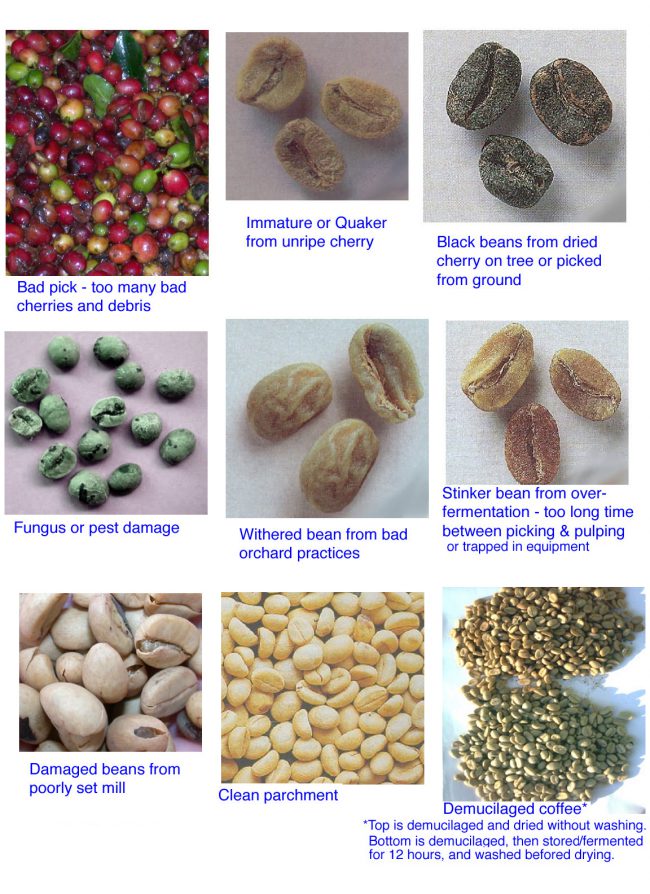
BEST PRACTICES: Coffee Wetmill Practices – How They Affect Your Coffee Quality by Ken Sheppard, September 29, 2008 Objective: The purpose of this workshop is to discuss wet mill practices with a particular emphasis on the fermentation process. Food for thought: If we accept that the coffee on the tree is the best it can…

Coffee Mucilage

BEST PRACTICES: COFFEE MUCILAGE by Nancy Griffith (what I have learned as of Oct 18, 2006) After harvesting and removing the skins [pulping] of coffee cherry, the mucilage needs to be removed from the seed.  The soft and slippery mucilage is actually the fruit of the coffee, as opposed to the skin and the seed. …